


Hiring a pool builder in Raleigh is one of those decisions that's hard to undo once construction starts. Get it right, and you end up with a backyard you actually use for the next twenty years. Get it wrong, and you're stuck with a builder who disappears mid-project, cuts corners on the parts you can't see, or leaves you to sort out a permitting mess on your own.
This guide walks through exactly what to check before you sign a contract: licensing, insurance, industry certifications, portfolio, reviews, construction process, materials, permitting, and the questions worth asking on your first call. We'll also cover how pool pricing actually works in the Raleigh market, since that's one of the most searched (and most misunderstood) parts of the process.
Why the Right Pool Builder Matters So Much
A pool isn't a weekend project. It's a permanent structure tied into your home's electrical system, plumbing, and grading, and it has to hold up through NC summers, freeze-thaw winters, and years of chemical exposure. A builder who cuts corners on rebar placement, plumbing slope, or electrical bonding can leave you with cracks, leaks, or safety issues that don't show up until years later.
The right builder also shapes how smooth the process feels. A good one keeps you informed, handles the permitting maze, and coordinates every trade so your backyard doesn't turn into a six-month waiting game. The wrong one turns a exciting project into a stressful one.
Step 1: Confirm They're Properly Licensed and Insured in North Carolina
First and foremost, protect your investment by ensuring your contractor meets state licensing standards. North Carolina law mandates that contractors overseeing major residential structural projects hold an active license with the North Carolina Licensing Board for General Contractors (NCLBGC). From excavation and pool shells to high-end decking and specialized equipment, custom pool construction involves extensive engineering and trade integration. Working with a properly licensed specialist isn't just best practice, it is a legal standard for professional pool building in Raleigh.
You can verify any contractor's license status yourself in a few minutes through the NCLBGC's public license lookup tool. It's free, and it will show you whether the license is active and in good standing. If a builder hesitates to give you their license number, that's a red flag on its own.
Insurance matters just as much. Ask to see a certificate of general liability insurance and proof of workers' compensation coverage, which is required by North Carolina law for most employers. Both protect you if something goes wrong on your property during construction.
Step 2: Look for Real Pool Industry Training and Certifications
A general contractor's license proves someone can legally run a construction project. It doesn't necessarily prove they know pool-specific hydraulics, structural engineering, or code requirements like NEC Article 680 for electrical safety around water.
That's where pool industry certifications come in. The Pool & Hot Tub Alliance (PHTA) runs the industry's main credentialing pathway, starting with the Certified Builder Professional (CBP) designation and progressing through Advanced, Expert, and Master levels. Builders who invest in this training have gone through structured coursework on concrete pool construction, hydraulics, and design, on top of whatever their state license already requires. It's a good sign, though plenty of excellent local builders build a strong reputation through hands-on experience rather than formal certification, so treat this as one data point among several, not a dealbreaker on its own.
Step 3: Decide Between a Design-Build Firm and Separate Contractors
Some homeowners hire a landscape designer, a separate pool contractor, a fence company, and a patio installer, then try to coordinate the schedule themselves. Others hire one design-build firm that handles the entire yard, pool included, under one contract and one point of contact.
The design-build model tends to reduce miscommunication, since the same team that draws the pool design is also responsible for building it, so there's no finger-pointing between a designer and a builder when something doesn't match the plan. It also usually means your pool, patio, and landscaping are planned together from day one instead of getting bolted on separately.
If you go the separate-contractor route instead, that's fine too, just budget extra time for coordinating schedules and confirm in writing who's responsible for what at each handoff point.
Step 4: Review Their Portfolio, Not Just Their Website Photos
Almost every builder's website shows their best work. What you actually want to see is a broad portfolio of completed, local projects, ideally ones similar in scope to what you're planning. Ask specifically about projects built on lots with clay soil, slope, or drainage challenges, since a lot of Raleigh and Wake County properties deal with exactly that, and a builder with real local experience will have stories and photos ready, not a blank stare.
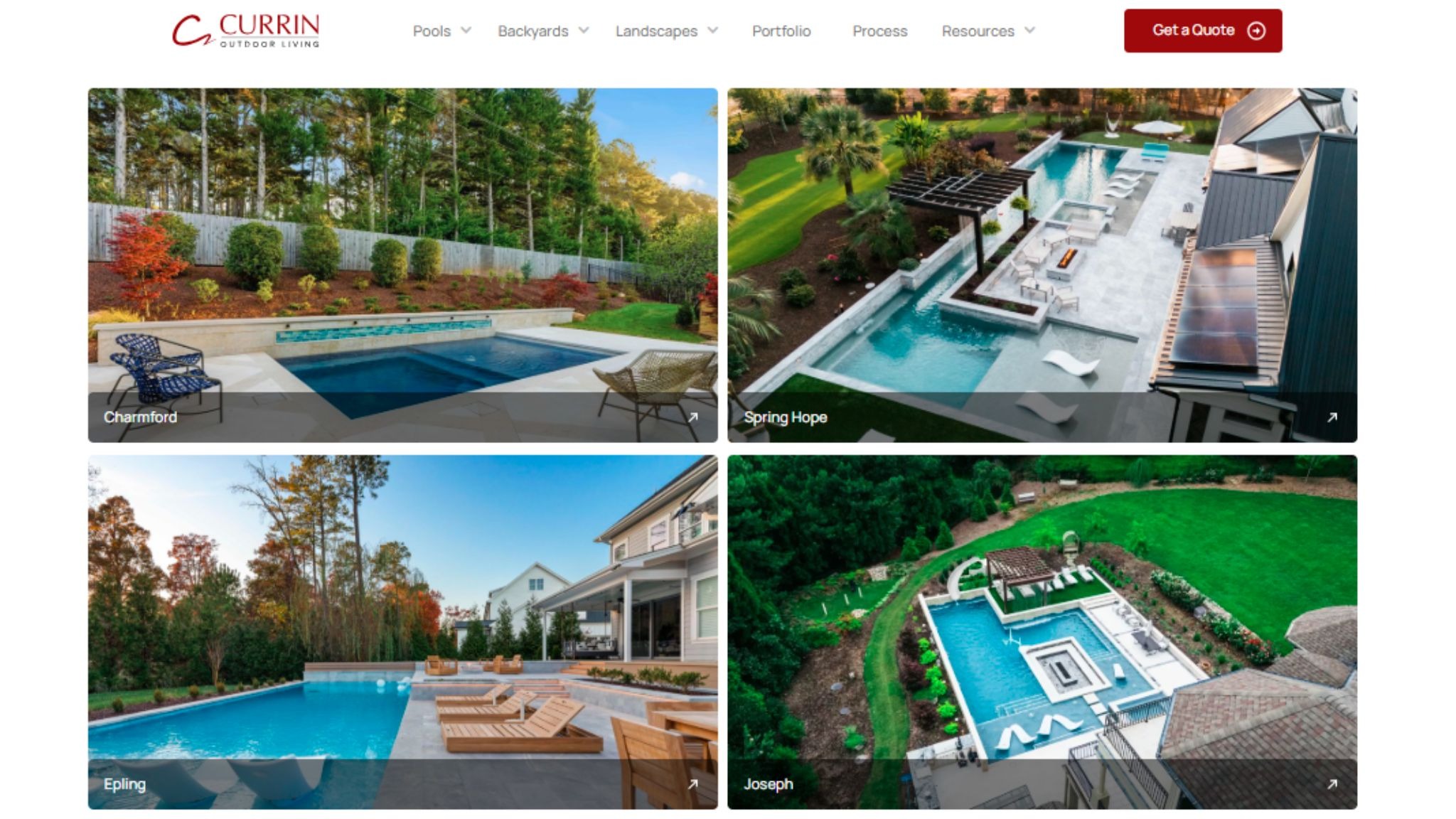
If possible, ask to see a project in person or talk to a past client directly. Photos hide a lot of small details that you'll notice standing on a real pool deck, like coping alignment, tile grout lines, and how well the transitions between materials were handled.
Step 5: Read Reviews Across Multiple Platforms
Don't stop at the testimonials on a builder's own website, since those are obviously curated. Check Google Reviews, Houzz, Yelp, and Facebook, and look for patterns rather than one bad review, since even great builders get an occasional unhappy client. What matters more is how the company responded: professionally and with an attempt to resolve it, or defensively and dismissively.
It's also worth checking the NCLBGC's license lookup for any complaint history tied to a contractor's license, since that's public record and a step most homeowners skip.
Step 6: Understand Their Construction Process, Start to Finish
A builder who can clearly walk you through their process, step by step, is usually a builder who runs organized projects. A typical custom pool build in Raleigh moves through stages roughly like this:
- Initial consultation and site walk to understand your goals, budget range, and site conditions
- Design and 3D renderings so you can see the pool, decking, and landscaping together before anything is built
- Permitting and engineering, including building, electrical, and sometimes plumbing permits through the city or county
- Excavation and steel, where the pool shape is dug and reinforcing steel is set
- Plumbing and electrical rough-in, installed before the shell is sprayed
- Gunite or shotcrete application, which forms the permanent structural shell
- Tile, coping, and decking, where the finish materials go in
- Startup and orientation, where the water is balanced and you're walked through how to run the equipment
At Currin Outdoor Living, this runs through a structured design, build, and maintain process with one team managing every phase, so you're never being handed off between separate companies mid-project.
Step 7: Ask About Construction Materials and Methods
Most custom in-ground pools in the Raleigh area are built using gunite or shotcrete, a sprayed concrete method that lets a builder create almost any shape, depth, or feature you want, from tanning ledges to attached spas. Vinyl liner and fiberglass pools are faster to install and can cost less, but they offer far less design flexibility and the liner or shell eventually needs replacing.
Ask which method your builder specializes in and why they'd recommend it for your specific yard. A builder who only offers one option isn't necessarily wrong for your project, but you want to understand the trade-offs before you commit.
Step 8: Confirm They Handle Permitting for You
Pool permitting in Wake County and the City of Raleigh touches building code, electrical code, zoning, and sometimes septic or floodplain review. A builder with real local experience will manage this process on your behalf instead of leaving you to navigate multiple portals and departments alone, and they'll know which neighborhoods carry extra requirements, like Historic District overlays or HOA architectural review.
How Much Does It Cost to Hire a Pool Builder in Raleigh, NC?
This is one of the most searched questions about pool building in Raleigh, and honestly, there's no honest way to answer it with a single number. Pool cost depends on so many site-specific variables that a flat, published price would be misleading for almost everyone who reads it.
The factors that move the number most include:
- Pool size, shape, and depth
- Whether you're adding a spa, water feature, tanning ledge, or slide
- Decking and patio material and square footage
- Site conditions like slope, tree removal, soil type, and drainage
- Access to the backyard for equipment (a tight side yard can add real cost)
- Fencing, lighting, and landscaping tied into the project
- Permitting complexity, including septic setbacks or floodplain review
Because of all this, reputable pool builders, Currin Outdoor Living included, generally don't publish set prices online. Instead, pricing is worked out after a site visit, where the builder can actually see your yard's grading, access, soil, and existing landscaping before putting a number to paper. Any builder who quotes you a firm price over the phone, sight unseen, should make you a little suspicious rather than relieved.
The most useful thing you can do is request a consultation with two or three local builders, walk your property with each of them, and compare not just the numbers you eventually get back, but how thorough and transparent each company is about what's included.
Questions to Ask a Pool Builder Before You Hire Them
- Are you licensed with the NCLBGC, and can I have your license number?
- Do you carry general liability insurance and workers' compensation, and can I see proof?
- Do you handle the permitting process, or is that on me?
- Is the crew that shows up to build my pool your own employees, or subcontractors?
- Can I see two or three completed projects near my neighborhood?
- What's your typical timeline from signed contract to final walkthrough?
- How do you handle change orders if something needs to shift mid-project?
- Who is my main point of contact once construction starts?
- What's included in your warranty, and how long does it last?
Why Homeowners Across Raleigh Choose Currin Outdoor Living
Currin Outdoor Living was founded by brothers with deep roots in design, horticulture, and construction, and has grown into one of the Triangle's established design-build teams, with 275 completed projects since 2016 and a combined team experience of over 80 years. Every phase, from the first pool design meeting through excavation, plumbing, electrical, and gunite, is handled in-house by the same crew, rather than handed off to a rotating cast of subcontractors.
You can see the range of what that looks like in practice across the project portfolio, from compact plunge pools to full resort-style backyards with spas, tanning ledges, and integrated outdoor kitchens.
Ready to Start Planning Your Pool?
Choosing a pool builder in Raleigh comes down to trust: licensing you can verify, a real local track record, and a process that keeps you informed instead of guessing. If you're ready to walk your property with a local team and talk through what's realistic for your backyard, request a consultation with Currin Outdoor Living or call (919) 234-7888. You can also browse completed, fully built projects throughout the Triangle in our portfolio.
Frequently Asked Questions
How do I find a good pool builder in Raleigh, NC?
Start by checking that the builder is licensed with the NCLBGC and carries proper insurance, then look at their local portfolio and reviews across multiple platforms. A strong local track record matters more than flashy marketing. You can browse a real local portfolio of completed Raleigh-area projects to see what a builder's actual work looks like, not just their best angles.
Do I need a licensed contractor to build a pool in North Carolina?
Yes, absolutely. Under North Carolina law, major residential projects require a licensed general contractor. Because custom in-ground pool construction encompasses everything from excavation and shell installation to surrounding decking and fine finishing, it virtually always falls under this legal requirement. That is why our comprehensive pool building process is seamlessly managed by a fully licensed, in-house team from start to finish.
How much does a pool builder cost in Raleigh, NC?
It depends entirely on your pool's size, features, materials, and site conditions, so there's no accurate flat number that applies to every yard. Reputable builders provide pricing after an in-person site visit rather than a phone quote. The best way to get a real number for your property is to request a consultation and walk the site with a builder directly.
What's the difference between a pool builder and a pool designer?
A pool designer focuses on the layout, look, and features of the space, often producing 3D renderings before construction starts. A pool builder handles the physical construction: excavation, steel, plumbing, electrical, and the concrete or gunite shell itself. Some companies specialize in only one side; others, like Currin, handle design and construction together as one connected process.
How long does it take to build a pool in Raleigh?
Timelines vary based on design complexity, permitting, and weather, but most custom in-ground pool projects take several months from signed contract to final walkthrough once you factor in permitting, excavation, curing time for the gunite shell, and finish work. A builder with strong local experience and an organized process will typically move faster and more predictably than one juggling multiple subcontractors.
Should I hire a design-build company or a separate designer and pool contractor?
Either can work, but a design-build company tends to reduce miscommunication since one team is accountable for the whole project instead of two separate companies pointing fingers if something doesn't match the plan. If you want your pool, patio, and landscaping to feel like one cohesive space rather than three separate projects, a design-build firm is usually the simpler path.
What questions should I ask a pool builder before signing a contract?
Ask for their license number, proof of insurance, who handles permitting, whether their crew is in-house or subcontracted, and what's included in their warranty. It also helps to ask what happens if a change comes up mid-project. If you'd like to talk through your specific site and questions directly, reach out to our team and we're happy to walk through what to expect.
Does Currin Outdoor Living build the pool, or just design it?
Both. Excavation, plumbing, electrical, forming, and finish work are all handled in-house by our own crews, so your project is built exactly as it was designed without being handed off to outside subcontractors. You can read more about our full pool building process, from pre-construction walkthrough to startup and orientation.

